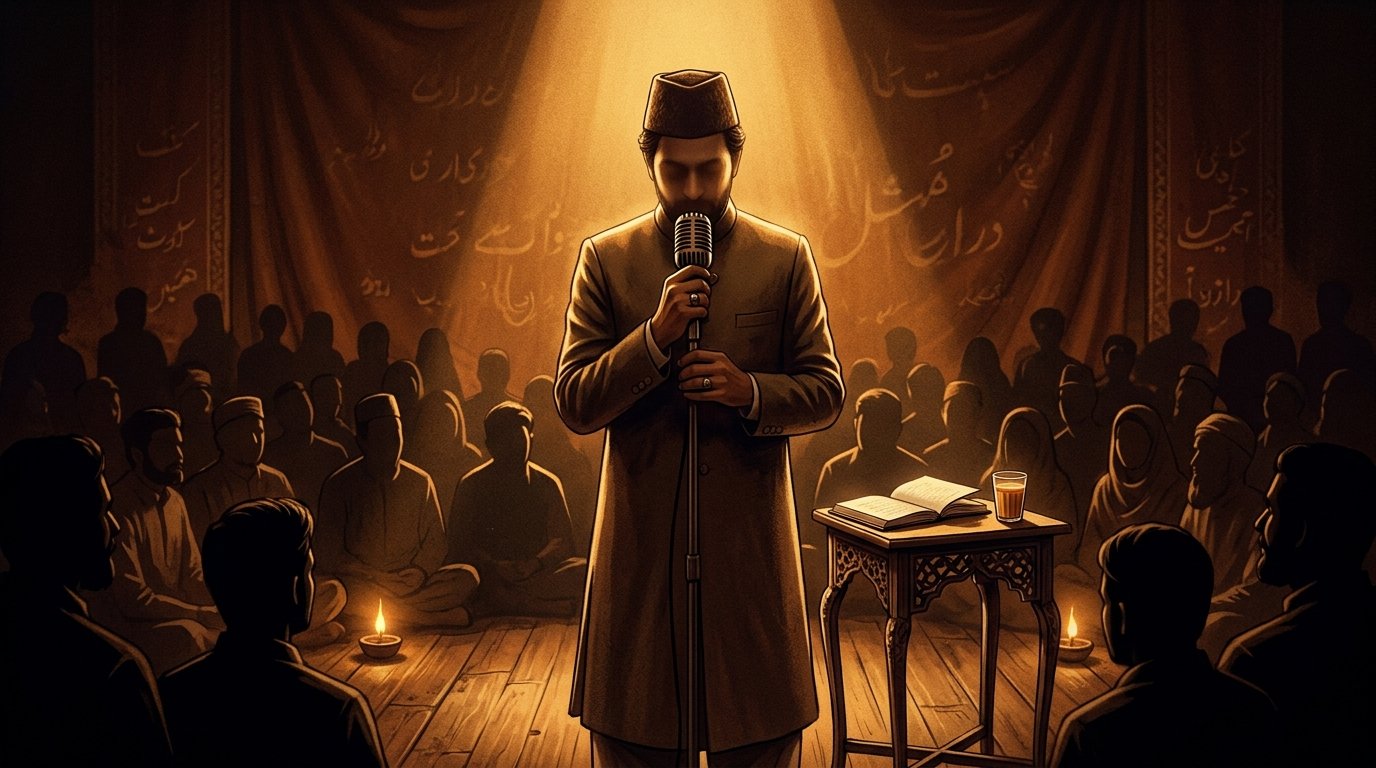
If you have scrolled through Urdu poetry pages on Instagram or caught a mushaira clip on YouTube, there is a good chance you have come across Azhar Iqbal shayari. His couplets travel fast because they sound like something a friend would say to you over chai, not lines pulled from a dusty old diwan. That conversational pull is exactly why so many readers search for Azhar Iqbal ki shayari, his ghazals, and his sher again and again.
This guide brings together everything worth knowing about the poet, his style, his most talked-about work, and where you can actually experience his poetry the right way. Instead of just dropping a list of lines, we will look at who Azhar Iqbal is, what makes his Urdu shayari distinct from the older masters, and how fans in India, Pakistan, and now the Urdu-Hindi diaspora in the United States use his poetry.

Who Is Azhar Iqbal
Azhar Iqbal Shayari is a contemporary Urdu poet, anchor, and scriptwriter born in 1978. He grew up in Budhana, a small town in Uttar Pradesh, India, and completed his education at Aligarh Muslim University before settling in Meerut, where he lives today. His background is not that of someone born into a literary family. By his own account, shared at a public event, his early years were shaped by financial struggle, with his father running a modest shop to support the household.
What started as a passion for poetry grew into a full career on the mushaira circuit. Azhar Iqbal Shayari now regularly performs at some of the biggest Urdu and Hindi literary gatherings in India, including Jashn-e-Rekhta, Jashn-e-Bahaar, and the Shankar Shaad Mushaira. Beyond the stage, he works as a television anchor and interviewer, and he comments frequently on both classical and modern Urdu literature, giving him a reputation as someone who understands the tradition while writing for a modern audience.
The Cricket Connection Behind His Name
One detail that surprises a lot of fans is the story behind his name. Azhar Iqbal Shayari is actually the name his father gave him at birth. As a schoolboy, he was such a devoted fan of cricketer Mohammad Azharuddin, who captained the Indian cricket team at the time, that he wrote “Mohammad Azharuddin” on his own tenth-grade board exam registration form. That decision meant his official school and legal records carried a different name for decades. He later spoke publicly about formally reclaiming his birth name, Azhar Iqbal, after living with the mix-up for more than three decades. It is a small story, but it says a lot about how personal and unfiltered his public persona is, which carries directly into his poetry.
Founder of the Harfkaar Foundation
In 2015, Azhar Iqbal Shayari founded the Harfkaar Foundation, an organization built to promote theatre, dastangoi, poetry, and other performing arts rooted in Urdu and Hindi literature. Through the foundation, he has helped bring literary performances to audiences who might not otherwise encounter classical storytelling formats, extending his influence beyond his own stage performances.
What Makes Azhar Iqbal Shayari Different
Urdu poetry has a long and demanding tradition, full of Persianized vocabulary that can feel distant to a casual reader. Azhar Iqbal Shayari takes a different route, and that choice is central to why his work resonates so widely.
Blending Hindi and Urdu Naturally
Azhar Iqbal Shayari is known specifically for weaving everyday Hindi vocabulary into the structure of the ghazal. Rather than leaning on heavy Persian or Arabic-origin words that require a glossary to understand, he builds his couplets around words people actually use in daily conversation. This is a deliberate stylistic choice, and it is one of the main reasons his Urdu shayari in Hindi feels accessible to readers who grew up speaking Hindustani rather than studying classical Urdu.
A Conversational, Performance-Ready Style
His ghazals are written with performance in mind. Many of his sher land with a punch when read aloud, which is part of why his mushaira appearances draw such a strong reaction from live audiences. The rhythm, the pauses, and the way a line sets up its own twist are all built for the stage as much as the page. This performance quality is a big part of what separates his famous shayari from poetry meant purely for silent reading.
Emotional Honesty Over Ornamentation
Where some ghazal writers lean heavily on metaphor layered over metaphor, Azhar Iqbal’s work tends to say the emotional truth plainly, then let one sharp image do the rest of the work. That balance between simplicity and depth is a hallmark readers mention again and again when they talk about his deep meaning shayari.
Popular Themes In Azhar Iqbal Poetry
Fans searching for Azhar Iqbal shayari usually fall into a few clear groups, based on the mood they are looking for.
Romantic and Ishq Shayari
A large share of his audience comes for his romantic shayari and mohabbat shayari, the verses that capture the early rush of falling for someone, the hesitation before saying it out loud, and the quiet comfort of being understood by one person. These pieces are some of the most shared Azhar Iqbal love shayari on social platforms, often used as WhatsApp status updates or Instagram captions by people trying to put their own feelings into words.
Judai and Dard Bhari Shayari
Separation is another recurring thread in his work. His judai shayari and dard bhari shayari deal with distance, waiting, and the particular ache of loving someone who is no longer within reach. This category overlaps heavily with what fans describe as his sad shayari or heart touching shayari, and it tends to be the content people return to during difficult personal moments.
Life, Reality, and Motivational Poetry
Not everything Azhar Iqbal writes is about romance. A meaningful part of his output addresses life itself, touching on loneliness, the passage of time, social observation, and quiet resilience. These pieces are closer to motivational poetry and life shayari, offering reflection rather than romantic longing, and they show a different, more philosophical side of his range.
Famous Azhar Iqbal Ghazals And Sher You Should Know
Rather than reproducing his copyrighted verses in full here, it is more useful to point you toward the titles and opening lines that fans and literary platforms most associate with him, so you can look them up and read or listen to the complete, properly credited work.
Pieces frequently mentioned among his famous sher and best shayari include lines that open with phrases like “ghutan si hone lagi,” “ek muddat se hain safar mein hum,” and ghazals built around themes captured in titles such as “Agar Aap Hamare Hote,” “Pehla Ishq Hai Tumhara,” and “Neend Aayegi Bhala Kaise.” His Rekhta profile also lists shorter, standalone sher, along with a qita, that circulate widely in screenshots and status posts, though they are easy to mistake for someone else’s work if you are not checking the source.
A smart habit, especially with poetry this widely shared online, is to always verify the attribution on a platform like Rekhta before quoting a couplet as Azhar Iqbal’s own. Misattribution is extremely common in the shayari space, where lines get copied and recopied without credit.
Azhar Iqbal Shayari In Hindi Urdu And English
Because his poetry naturally blends Hindi vocabulary into an Urdu ghazal structure, Azhar Iqbal Shayari work is unusually easy to read across scripts. You will find his couplets transliterated in Roman Urdu and Roman Hindi on fan pages, written in the Nastaliq script on literary archives, and occasionally translated into English on platforms aimed at non-Hindi, non-Urdu readers. If you are new to Urdu poetry, reading his work in Roman script alongside a literal English sense of the line is often the easiest entry point, since the vocabulary itself is already closer to spoken Hindustani than classical Urdu tends to be.
Where To Read And Watch Azhar Iqbal’s Poetry
For anyone who wants to go past scattered social media posts, a few sources stand out as reliable.
Rekhta, one of the largest online archives of Urdu and Hindi poetry, hosts a dedicated profile for Azhar Iqbal with his ghazals, individual sher, and a qita, all properly credited and searchable. YouTube is the other major home for his work, with dozens of recorded performances from mushairas where you can watch him deliver his poetry live, including gatherings like Jashn-e-Rekhta. Watching a live mushaira recording is genuinely one of the best ways to understand his poetry, since so much of its effect comes from timing and delivery rather than the text alone.
How Fans Use Azhar Iqbal Shayari
A lot of the day-to-day search interest around this poet comes from people looking for lines to use in a specific moment, not from literary researchers. Short two-line shorthands work well as WhatsApp status updates and Instagram captions because they deliver a complete emotional thought without needing context. Longer ghazals, on the other hand, are better suited to quiet reading time, since the full emotional arc needs more than one couplet to land properly.
If you are picking a line for a caption or status, matching the mood of the moment matters more than picking the most popular line you can find. A judai sher posted on a happy day reads oddly, just as an upbeat line feels out of place during a genuinely hard week.
Common Mistakes To Avoid
One frequent error is treating any emotional Urdu couplet found online as automatically being Azhar Iqbal’s work. Shayari spreads through screenshots with no attribution attached, and plenty of lines get wrongly credited to well-known poets simply because they sound similar in tone. Always check a credited source like Rekhta before sharing something under his name.
Another common mix-up is confusing Azhar Iqbal Shayari with other poets who share part of his name, including the well-established poet and lyricist Iqbal Ashhar. The two are different people with different bodies of work, so double-check which poet a line actually belongs to before quoting it.
Finally, pairing a serious ghazal with the wrong kind of visual or caption on social media can strip the line of its meaning. Poetry this specific about emotion deserves a setting that matches its tone.
Frequently Asked Questions
Final Thoughts
Azhar Iqbal has built a distinct place for himself in contemporary Urdu poetry by refusing to make his audience work too hard to feel something. His shayari leans on plain, honest language and a performance-ready rhythm, which is why it travels so easily from a mushaira stage to a phone screen. Whether you are drawn to his romantic lines, his verses on separation, or his quieter reflections on life, the best way to experience his work fully is still through a credited source and, if you can find a recording, through his own voice reciting it.
Sources:
- Azhar Iqbal profile on Rekhta
- Azhar Iqbal speaker profile, Kalinga Literary Festival
- Amar Ujala, Samwad 2025 coverage on Azhar Iqbal
- Ghazal, Wikipedia